

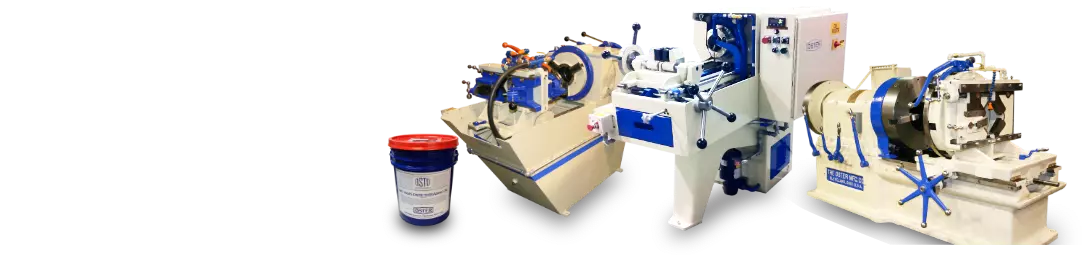
Industrial Production vs. Plumber/Contractor-Grade Pipe Threading Machines
Which Type of Pipe Threading Machine is Right for Your Production?
When determining which pipe threading machine is right for you, you’re going to need to choose between a manual or an automatic model. Manual pipe threading machines are better for home use. Industrial-grade automatic threading machines are better suited for plumbers and contractors, as those machines are built for jobsite-level work.
For real production, prefabricated waterworks, anchor bolt threading, rod threading, data center conduit threading, or fire sprinkler pipe threading, you need a production automatic pipe threading machine that is made for the industrial environment. Efficient, cost-effective threading isn’t done on the jobsite, and it isn’t done on a machine made for one.
Both commercial-grade and industrial-grade pipe threading machines will cut threads and reduce manual labor. But choosing the correct machine for your needs requires careful consideration and comparison. At Oster, our industrial threading machines:
- Run multiple shifts
- Ensure repeatable thread lengths
- Quickly grip materials
- Tackle any pipe or bolt thread (even British thread!)
- Perform stainless steel and Grade 55 threading
For industrial production, choose an Oster pipe threading machine. Keep reading to learn more and make the best selection for your needs. Contact us with any questions or for more information.
Comparing Industrial Production to Plumber/Contractor-Grade Threading Machines
Duty Cycle and Daily Volume
Plumber-grade threading machines are made for intermittent threading for maintenance or piecework on the jobsite. Smaller motors, more aluminum, and lighter-weight contractor-grade threading machines are made for occasional cuts, not continuous runs. They are designed to handle production runs from 2-300 lbs. and 35-60 RPM. Their operating life is measured in years, and they are not designed for decades of continuous use or running all day, every day.
Oster threading machines are designed from the ground up to run for decades with minimal downtime during multiple shifts. They are purpose-built for industrial and manufacturing threading applications. With a heavy fabricated frame and solid castings, our machines are built to last. In particular, our flagship 792A pipe threading machine will cut ACME threads in a single pass without fail. Our machine motors are 5 to 7 horsepower and sized with plenty of torque for full-depth, single-pass threading of high-strength steel and stainless steel.
Rotating Diehead vs. Rotating Spindle
In plumber-grade threading machines, the material rotates while the die remains stationary. This setup is convenient for threading short, straight pipe. However, because the material rotates, long or bent material can whip around the back of the machine, necessitating slower speeds and creating additional safety hazards.
Oster industrial threading machines feature rotating dieheads to keep the material stationary. This results in a smaller danger zone, an easier structure for the production cell, and no risk of whipping material. Our 792A machine features the X1 rotating diehead, which can easily thread long bolts, threaded rod, fire-sprinkler pipe, bent stock, J-bolts, l-bolts, long conduit, brace rods, turnbuckles, and welded pipe assemblies.
Note: The most important feature of a rotating diehead is the increase in production speed. When using a machine that rotates the material, much of your production time is spent waiting for the spindle to stop and come back up to speed. With a rotating diehead, wait times are reduced to nothing—by returning the carriage to the start position, the diehead resets automatically and the next piece can be loaded immediately.
Repeatability at Production Speed
Contractor-grade machines consist of a “one size fits all” thread-length feature. This design can work for one-off projects, but doesn’t allow for precision control. Motor speeds are not infinitely variable on most plumber-grade machines—they feature set speed options and limited control for fine-tuning your material, and typically top out at around 70 RPM.
The Oster 792A machine features automatically controlled thread length for both pipe and bolt. An operator can walk away from the machine or load another machine and still have a repeatable thread length every time. The stock position is controlled by the machine, ensuring that every part is the same. An infinitely variable frequency drive allows the operator to dial in the fitting surface speed for your material, providing precision control for tuning, finishing, and maximizing the dies' duty cycle. Class 2A threads can be cut in a single pass without chasing.
Thread Form Range and Material Capability
Plumber-grade machines are built around plumber threads. NPT is the primary focus, and bolt threading is an afterthought or a secondary feature. Bolt dies for plumber-grade threading machines are limited in availability and often face long lead times and high prices. It can be even more challenging to source dies for specialty threads such as metric, fine, ACME, British Pipe, left-hand, and double-lead threads.
At Oster, we manufacture a full range of thread forms: NC, NF, NS, NPT, NPTF (Dryseal), NPSM, ACME, BSPT, BSPP, and metric — all available in left-hand as well. In our machines, bolt threading isn’t reduced to an afterthought; it’s a first-class priority. Our machines can handle bolts sized from ¼” through 2” in a single pass.
We thread a wide variety of materials, including pipe, threaded rod, anchor bolts, copper, PVC, vinyl ester resin, fiberglass rod, galvanized pipe, galvanized bolts, conduit, structural steel stock, Hastelloy, bronze, brass, iron, monel, Inconel, titanium, and stainless steel.
Long-Term Value and Cost Per Thread
Plumber/contractor-grade threading machines are cheaper to purchase, but they have higher long-term costs. They typically provide lower throughput, resulting in higher labor costs. A threading operator is required to ensure repeatable thread lengths. With these machines, there is a greater risk of errors, rework, or faulty parts. Plumber-grade machines aren’t built to last; they’re designed to be replaced.
An Oster industrial threading machine will perform for decades, can be rebuilt, and then run for more decades. While our machines have a higher upfront cost, the long-term savings and performance provide an unmatched ROI. Our threading machines offer several unrivaled advantages:
- Lower labor costs
- Higher productivity
- Longer functional lifespans
- Fewer scrapped parts
- Shorter cycle times
- Fully repairable and maintainable
Our machines are made entirely in the USA with almost entirely USA-made components: Our castings come from Ohio, and our machines, parts, and tooling are manufactured at our Michigan facility.
Our factory refabrication program ensures sustainable performance for the next generation. These machines are not tools you use for 3 years and then replace. They’re tools you use for 20 years, rebuild, and run for another 20 years, all the while outproducing your competition and lowering your labor costs.
How to Select the Right Pipe Threading Machine for Your Operations
When To Choose a Plumber/Contactor-Grade Threading Machine
A plumber/contractor-grade threading machine may be your choice if:
- Threading is occasional or maintenance-based, not a key part of your operations.
- You’re performing low-volume NPT threading.
- Jobsite work necessitates mobility.
- You are motivated by the cheapest cost and don’t mind cheap quality.
- Your operators pay attention 100% of the time and never take a break.
When to Choose an Industrial Production Threading Machine
An industrial production threading machine is a better choice for you if:
- Threading is a key part of your production process: Pipe nipples, anchor bolts, threaded rod, fire sprinkler pipe, conduit assemblies, and prefab data center waterworks.
- Daily output is measured in hundreds or thousands of pieces, not dozens.
- You’re threading long material lengths or long thread lengths.
- Thread length and form must be repeatable across thousands of parts.
- Your work mix includes thread forms beyond NPT (NC, NF, ACME, BSPT, BSPP, metric, and left-hand).
- Labor cost per part matters, and total cost of ownership matters more than acquisition costs.
At Oster, we build the machine, we make the parts, and we produce the tooling. We make all of our threading dies in-house in a range of tool steels. We know our product from the ground up. Our threading machines are designed to last generations—and they do.
Contact Oster to Learn More!
At Oster, we have over 130 years of experience building industrial-grade pipe and bolt threading machines. All of our machines are 100% made in the USA, and we maintain a selection of replacement parts and tools to provide you with the components you need for your threading operations. As your trusted experts in industrial pipe threading, we’re here to help you find the best machine for your application.
Contact us for more information or request a quote and get started on your order today!
